Modern Money Life

Costs & Expenses

Costs & Expenses

Why prices keep rising and what's really driving the cost of living higher. Understanding the forces that make everything from groceries to housing feel increasingly unaffordable.

A gallon of milk that cost $2.50 in 2015 now costs over $4 in most U.S. metro areas — and that pattern repeats across nearly every household expense.

Why Costs Rise Faster Than Income

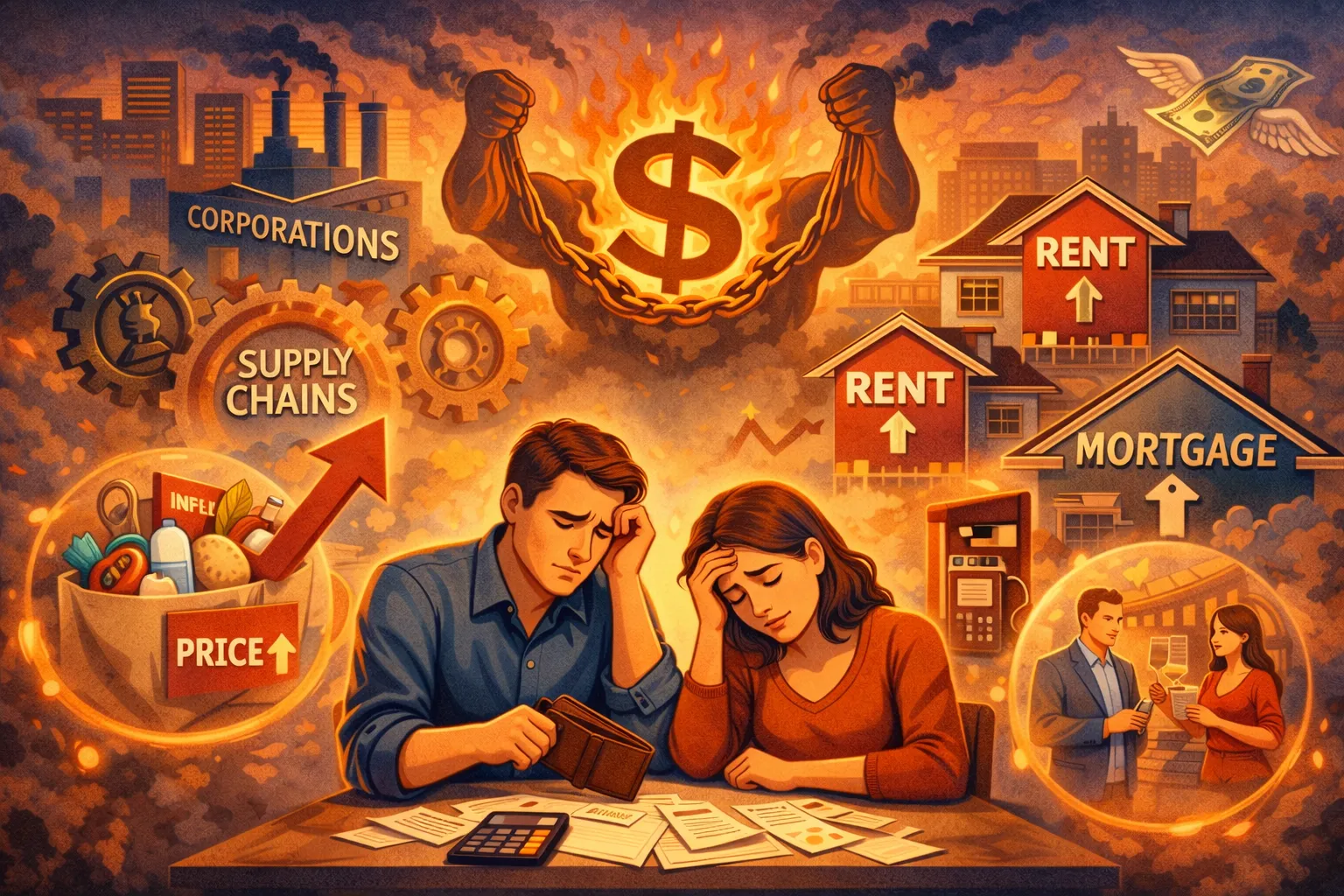
The feeling that everything costs more isn't a perception problem. Between 2000 and 2024, cumulative inflation exceeded 80% as measured by the Bureau of Labor Statistics Consumer Price Index. Over that same period, median household income rose roughly 20% in real (inflation-adjusted) terms. But that aggregate number masks the reality: the categories where people spend the most — housing, healthcare, education, childcare, and insurance — have inflated far faster than the overall average. The things you can skip have gotten cheaper. The things you can't have gotten dramatically more expensive.

Understanding why requires looking at the specific forces driving each category, because the causes aren't uniform. There is no single villain. There are multiple structural pressures, each reinforcing the others, creating an environment where prices ratchet upward and rarely come back down.

Housing Supply Constraints

Housing is the largest expense for most households, and its cost trajectory has been punishing. Median home prices have roughly doubled since 2012, according to the Federal Reserve Bank of St. Louis. Rents have followed a similar path, with the national median exceeding $2,000 per month in 2024. The fundamental driver is a supply shortage: the National Association of Realtors estimates the U.S. is short approximately 4 to 7 million housing units relative to demand.

That shortage didn't happen by accident. Zoning restrictions in high-demand metro areas limit density. Permitting processes add years and hundreds of thousands of dollars to construction timelines. After the 2008 financial crisis, residential construction collapsed and never fully recovered — homebuilders produced fewer units per year throughout the 2010s than in any decade since the 1960s. Meanwhile, population growth, household formation, and institutional investors entering the single-family market all increased demand. When supply is constrained and demand grows, prices rise. The mechanism is straightforward even if the politics of fixing it are not.

Market Concentration and Corporate Consolidation

Across major consumer sectors, the number of competitors has shrunk through decades of mergers and acquisitions. Four companies control roughly 85% of U.S. beef processing. Four airlines carry about 80% of domestic passengers. Three pharmacy benefit managers handle nearly 80% of prescription drug claims. When a handful of companies dominate a market, competitive pressure on pricing weakens. There's less incentive to undercut rivals and more ability to raise prices in lockstep.

This consolidation affects costs both directly and indirectly. Direct effects include higher shelf prices where competition has thinned. Indirect effects include reduced wage competition — in concentrated labor markets, fewer employers mean less pressure to raise pay, widening the gap between what things cost and what people earn.

Insurance Risk Pricing

Insurance premiums have become one of the fastest-growing household expenses across multiple categories. Auto insurance increased roughly 20% in 2023 alone, according to the BLS. Homeowners insurance has spiked in disaster-prone regions, with some states seeing 30-50% increases in a single year. Health insurance deductibles have roughly tripled over the past decade, shifting thousands of dollars in annual cost from insurers to policyholders.

The drivers vary by category but share a common thread: rising underlying costs that insurers pass through to consumers. More expensive vehicles cost more to repair. Climate-related property damage is increasing in frequency and severity. Healthcare costs continue to outpace general inflation. Insurers price risk based on claims experience, and when claims costs rise, premiums follow — often with a lag that produces sudden, jarring increases rather than gradual ones.

Healthcare Opacity

Healthcare costs in the U.S. are uniquely resistant to the normal forces that constrain prices in other markets. Patients rarely know what a procedure costs before receiving it. The same service can vary by 500% or more between facilities in the same city. Insurance negotiations happen behind closed doors, producing prices that bear little relationship to the actual cost of delivering care. And in emergencies, patients have no ability to compare options at all.

The result is a system where prices are largely disconnected from competitive market forces. U.S. healthcare spending now exceeds $4.5 trillion annually — roughly $13,500 per person — and consumes a growing share of both household budgets and employer compensation. When employers pay more for health coverage, that money comes from the pool that would otherwise fund wage increases, creating yet another channel through which rising costs suppress income growth.

Shrinkflation: The Hidden Price Increase

Not all price increases show up as higher numbers on the shelf tag. Shrinkflation — reducing the quantity in a package while maintaining the same price — has become a widespread strategy across food, household products, and consumer goods. A bag of chips drops from 10 ounces to 8.5 ounces. A roll of paper towels loses 20 sheets. A jar of peanut butter adds a deeper indent in the bottom. The price stays the same, but the unit cost rises 15-20% without triggering the sticker shock that an equivalent price increase would.

This matters beyond the individual product because it makes inflation systematically harder for consumers to track. The CPI attempts to account for shrinkflation, but in practice, shoppers experience it as a vague feeling that money doesn't go as far — without a clear price signal to point to. It compounds the psychological burden of managing a household budget when even stable-looking prices are quietly delivering less.

Regulatory Factors and Interest Rate Transmission

Regulation affects costs in both directions, and its absence can be as expensive as its presence. Environmental and safety regulations add costs to construction, manufacturing, and compliance — costs that are ultimately passed to consumers. But deregulation in sectors like banking and telecommunications has often led to consolidation rather than competition, producing higher prices rather than lower ones. The relationship between regulation and cost is more complicated than either political narrative suggests.

Interest rates act as a transmission mechanism that amplifies or dampens cost pressures across the economy. When the Federal Reserve raised rates from near zero to over 5% between 2022 and 2023, the effects cascaded through mortgage rates, auto loan rates, credit card rates, and business borrowing costs. Higher borrowing costs increase the monthly payment on the same house or car, effectively raising the price of everything purchased on credit. For households already carrying significant debt, rate increases function as a direct cost increase on existing obligations — money that could have gone toward savings or essentials instead goes to interest payments.

None of these forces operate in isolation. Housing supply constraints interact with interest rate policy. Market concentration interacts with regulatory environments. Healthcare opacity interacts with insurance pricing. The compounding effect is an economy where the cost of participation rises faster than the income most people earn from participating in it. Understanding these mechanisms won't make prices lower, but it does clarify why the experience of modern financial life feels the way it does — and why the advice to simply "cut back" misses the structural reality of what's actually happening.

All Costs Articles