Modern Money Life

Debt & Pressure

Debt & Pressure

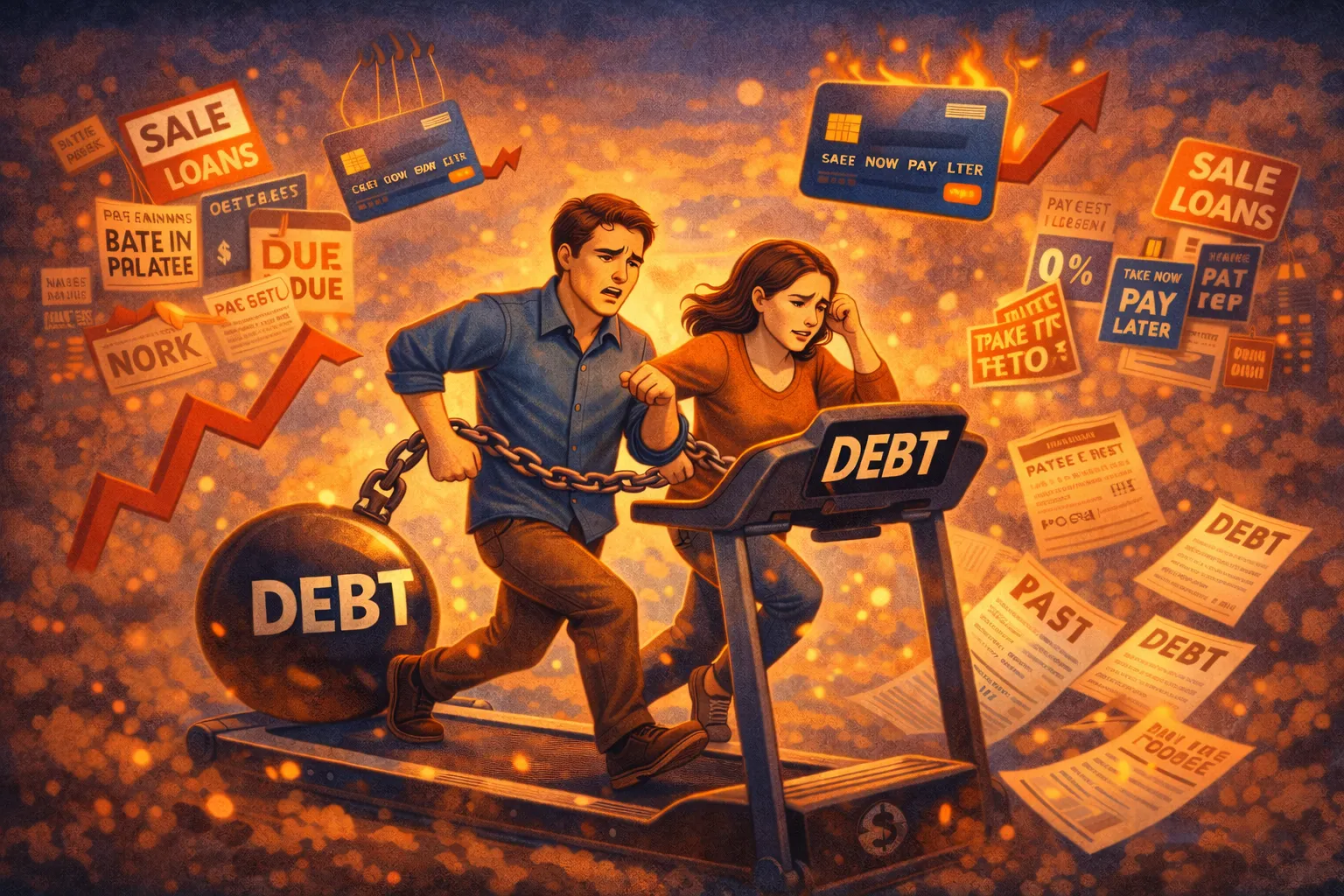
Why debt has become woven into the fabric of modern life. Understanding the forces that normalize borrowing and make escaping debt feel like running on a treadmill.

The average American household carries over $100,000 in total debt, including mortgages, student loans, and credit cards.

Why Debt Became Normal in Modern Life

In 1980, total U.S. household debt was approximately $1.4 trillion. By the end of 2024, it had surpassed $17.7 trillion, according to the Federal Reserve Bank of New York's Quarterly Report on Household Debt and Credit. Even adjusted for inflation and population growth, the increase is staggering — real per-capita household debt has roughly tripled over four decades. Debt is no longer something that happens to people who make mistakes. It's the financial infrastructure that most American households operate within every day.

This transformation didn't happen because people became less responsible. It happened because the cost of essential goods and services grew faster than wages, and credit expanded to fill the gap. Understanding how debt became the default condition of modern financial life requires looking at the specific mechanisms that made borrowing both easier and more necessary.

How Interest Rate Mechanics Work Against Borrowers

Interest is the price of borrowing money, and for consumer debt, the price has been remarkably high relative to what lenders themselves pay. When the Federal Reserve's benchmark rate sat near zero from 2009 to 2015 and again from 2020 to 2022, banks could borrow at essentially no cost. Credit card interest rates during those same periods averaged 15-17%. By 2024, with the federal funds rate above 5%, average credit card APRs exceeded 22%, according to the Federal Reserve's G.19 Consumer Credit report.

The mechanics of compound interest on revolving debt are particularly punishing. On a $5,000 credit card balance at 22% APR, making the minimum payment (typically 1-2% of the balance or $25, whichever is greater) means paying over $8,000 in interest and taking more than 20 years to reach zero — assuming no additional charges. The minimum payment structure, which the CFPB has studied extensively, is calibrated to keep balances active as long as possible while maintaining the appearance of progress. Each month, the majority of the payment goes to interest rather than principal, creating the experience of paying constantly while the balance barely moves.

The Normalization of Credit Culture

A generation ago, carrying credit card debt was broadly understood as a temporary situation to be resolved quickly. Using credit for groceries or gas would have struck most people as a sign of financial distress. That framing has shifted. According to a LendingClub report, roughly 60% of Americans now live paycheck to paycheck, and for many of them, credit cards function not as a convenience but as a bridge between income and obligations.

The normalization of debt has been reinforced at every level. Student loans are presented as an investment rather than a burden. Car loans stretching to 72 or 84 months are marketed as affordable monthly payments. Mortgage products offer 3% down payments that maximize the amount borrowed. The cultural message has shifted from "avoid debt when possible" to "manage your debt effectively" — a reframing that accepts permanent indebtedness as a baseline condition rather than a problem to solve.

Credit scoring reinforces this dynamic. A credit score doesn't measure financial health — it measures how reliably you service debt. Someone with no debt at all may have a lower credit score than someone carrying $50,000 in obligations who makes consistent minimum payments. The system rewards active borrowing and penalizes its absence, creating a financial environment where participating in debt is required for access to housing, transportation, and sometimes employment.

Buy Now, Pay Later: The New Debt Layer

Buy-now-pay-later (BNPL) services — Affirm, Klarna, Afterpay, and similar platforms — have added an entirely new layer of consumer debt that barely existed before 2019. According to the CFPB's 2023 report on BNPL, the number of BNPL loans originated by the top five lenders grew from 16.8 million in 2019 to 180 million in 2022 — a tenfold increase in three years.

BNPL appeals precisely because it doesn't feel like debt. There's no credit card, no interest charge (in many cases), and no lengthy application. A $200 purchase becomes four payments of $50, and the psychological weight of spending $200 is diffused into something that feels manageable. But the aggregate effect is significant: BNPL users carry an average of 3-5 active installment plans simultaneously, according to CFPB data. The total amount owed may be modest for each plan, but the cumulative obligations — layered on top of existing credit card balances, student loans, and auto payments — create a complex web of due dates and minimum amounts that increases the likelihood of missed payments and late fees.

The Financialization of Everyday Life

Financing has expanded into categories where it barely existed a decade ago. Phones are financed over 24-36 months through carrier installment plans. Furniture is purchased on interest-free promotional periods that convert to 25%+ retroactive interest if not paid in full by the deadline. Veterinary care, dental work, home repairs, and even clothing are available on point-of-sale financing. Each transaction is positioned as a convenient payment option rather than what it actually is: a new debt obligation.

This expansion of financing has been enabled by technology and data. Real-time credit decisioning allows retailers to offer loans at checkout in seconds. Algorithmic underwriting extends credit to borrowers who would have been declined under traditional criteria. The friction between wanting something and owing money for it has been reduced to a single tap. The result is a financial landscape where nearly any purchase, regardless of size, can become debt — and increasingly does.

Medical Debt: The Involuntary Crisis

Most debt carries at least the pretense of choice. You chose to take the student loan, finance the car, use the credit card. Medical debt is different. It often arrives without warning, without consent, and in amounts that bear no relationship to what the patient expected or could have planned for. According to the Consumer Financial Protection Bureau, approximately 100 million Americans — roughly one in three — carry some form of medical debt. A study published in the American Journal of Public Health found that medical expenses contribute to approximately 66% of all personal bankruptcies in the United States.

Medical debt interacts with other forms of debt in cascading ways. An unexpected $3,000 emergency room bill gets put on a credit card because there's no savings buffer. The credit card balance grows. Minimum payments increase. Other bills get delayed to cover the new minimum. Late fees accumulate. Credit scores drop. The cost of future borrowing increases. A single medical event can destabilize a household's entire financial position — not because of the original amount, but because of the chain reaction it triggers through an already-strained system.

The Psychological Weight of Carrying Debt

The financial cost of debt is measurable — interest paid, fees charged, opportunities forgone. The psychological cost is harder to quantify but often more damaging. Research published in the Journal of Economic Psychology has found that debt is associated with higher rates of anxiety, depression, and relationship conflict, with effects that persist even when controlling for income level. The stress of debt isn't proportional to the amount owed — it's proportional to the feeling of being trapped.

Debt creates a specific form of cognitive load: the constant background awareness that money owed exists, that payments are coming due, that the balance isn't shrinking fast enough. This awareness competes for the same mental resources that people need for decision-making, problem-solving, and long-term planning. Research on scarcity from economists Sendhil Mullainathan and Eldar Shafir suggests that financial pressure functionally reduces cognitive bandwidth — the equivalent of losing roughly 13 IQ points. Debt doesn't just cost money. It costs cognitive capacity, making it harder to make the clear-headed decisions that might help resolve it.

The normalization of debt in modern life means that these psychological effects are widespread and largely invisible. Most people carrying debt don't talk about it. They assume their situation is unique, their stress is a personal weakness, and their inability to pay it off faster reflects individual failure rather than systemic design. It isn't. The debt economy was built to function exactly this way — not through conspiracy, but through the accumulated incentives of an industry where keeping people in debt is more profitable than helping them out of it. Recognizing that structure is the first step toward navigating it without the added burden of shame.

All Debt Articles