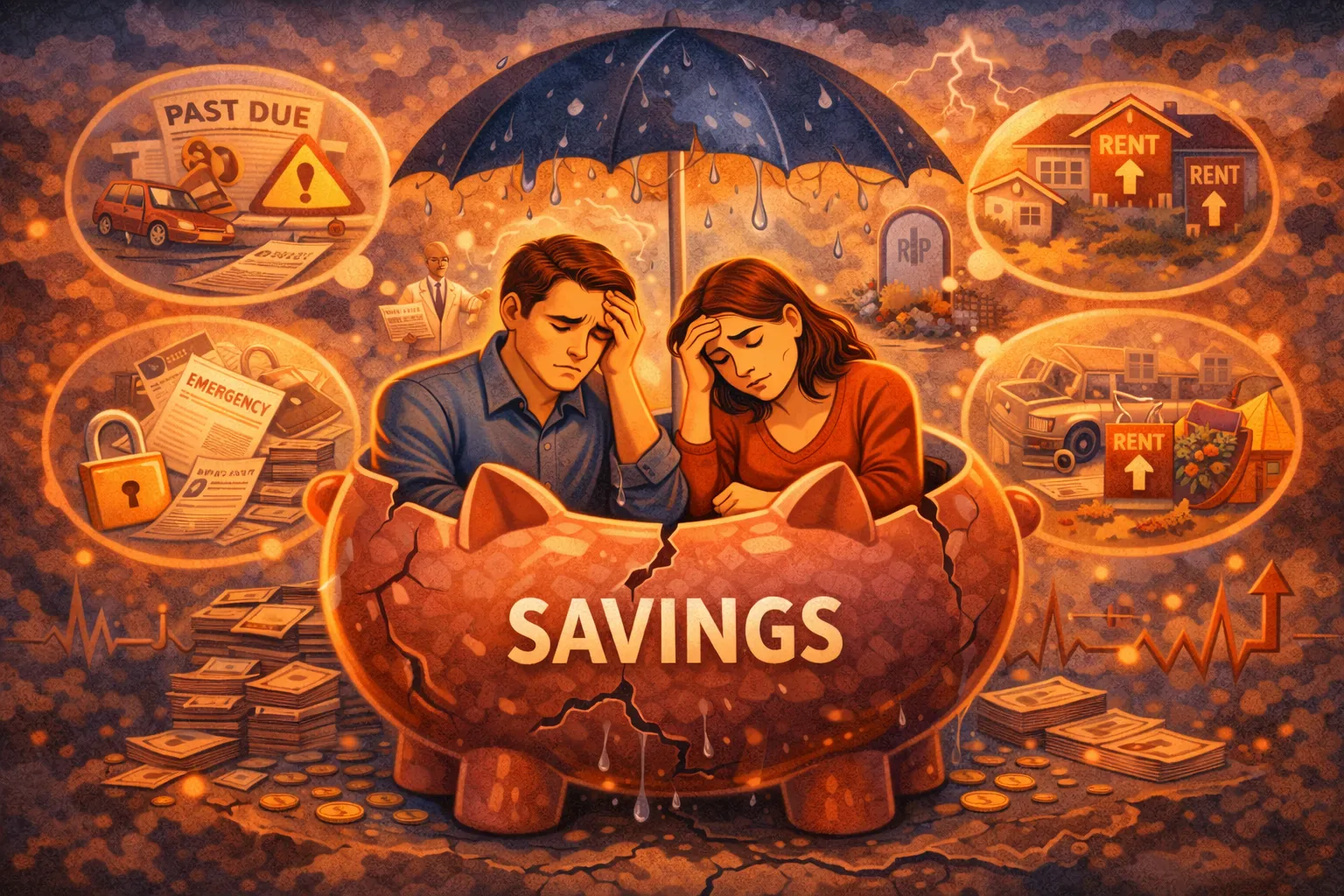
Why building financial stability feels impossible and what keeps us one unexpected bill away from crisis. Understanding the barriers to saving, the confusion around insurance, and the anxiety of planning for an uncertain future.
Over half of Americans cannot cover a $1,000 emergency expense without borrowing, despite decades of advice to build an emergency fund.
The advice hasn't changed in decades: pay yourself first, build an emergency fund, save 20% of your income, max out your retirement contributions. The advice assumes a financial environment that, for most Americans, no longer exists. When the cost of essentials consumes the majority of household income before discretionary spending even begins, saving becomes a mathematical impossibility for millions of people — not a character failure, but an arithmetic one.
Saving requires a surplus — income that remains after obligations are met. That surplus has been shrinking for decades. According to the Bureau of Labor Statistics, real median hourly wages have grown roughly 16% since 1979, or less than 0.4% per year. Over the same period, housing costs have grown approximately 55% in real terms, healthcare premiums have roughly doubled, and public university tuition has increased over 100%, according to Federal Reserve and BLS data.
The result is a structural squeeze. A household earning the median income in 1985 could cover housing, healthcare, transportation, and food with roughly 55-60% of gross income, leaving a meaningful margin for saving. Today, those same categories consume 70-80% or more of median household income in many metro areas. The standard advice to save 20% assumes a 20% surplus exists. For a growing share of households, it doesn't. The problem isn't discipline. It's that wages haven't kept pace with the cost of the things you can't choose not to buy.
The U.S. personal savings rate — the percentage of disposable income that households save rather than spend — tells the story in aggregate. In the early 1970s, the personal savings rate averaged roughly 12-13%, according to the Bureau of Economic Analysis. By the mid-2000s, it had fallen below 3%. It spiked temporarily during the pandemic (reaching 32% in April 2020 due to stimulus payments and reduced spending opportunities) before falling back to approximately 3.5-4.5% by late 2024.
A national savings rate under 5% means that the typical household is saving pennies on every dollar earned. At that rate, building even a modest emergency fund takes years, and building retirement savings sufficient for a multi-decade retirement is functionally impossible without employer contributions or above-median income. The declining savings rate isn't a reflection of national irresponsibility. It's a reflection of national cost structure — when more of every dollar is claimed by obligations, less is available for everything else.
The standard recommendation is three to six months of expenses in accessible savings. According to a Bankrate survey, approximately 57% of Americans cannot cover a $1,000 unexpected expense from savings alone. The Federal Reserve's Survey of Household Economics and Decisionmaking (SHED) found that roughly 37% of adults would struggle to cover a $400 emergency expense without borrowing or selling something.
These numbers have remained stubbornly persistent despite years of financial literacy campaigns, budgeting apps, and automated savings tools. The persistence suggests that the barrier isn't awareness or willpower — it's structural. People know they should have an emergency fund. They've been told thousands of times. The reason they don't is that building one requires money that has already been allocated to rent, groceries, insurance, debt payments, transportation, and childcare. The fund doesn't get built because the surplus to build it with doesn't exist.
For the money that does get saved, the returns have been discouraging for most of the past two decades. From 2009 to 2022, standard savings accounts paid near-zero interest — typically 0.01% to 0.06% APY — while inflation averaged roughly 2% annually. Money in a savings account was losing purchasing power every year. You deposited $1,000 and a year later it could buy less than when you saved it.
The rate environment shifted in 2023-2024, with high-yield savings accounts offering 4.5-5.0% APY. But this coincided with inflation running at 3-6%, meaning the real (after-inflation) return remained modest — roughly 1-2% in the best case. And the high-yield rates require actively seeking out online banks, transferring funds, and monitoring rate changes — a level of financial management that itself creates friction. Meanwhile, the prices of everything the savings are meant to cover continue rising, so even positive real returns may not keep pace with the specific costs a saver is trying to prepare for — healthcare costs, for example, have historically outpaced both general inflation and savings account returns by wide margins.
The gap between what Americans have saved for retirement and what they'll need is measured in trillions. The National Institute on Retirement Security estimates the national retirement savings deficit at approximately $14 trillion. According to Vanguard's How America Saves report, the median 401(k) balance for workers aged 55-64 is roughly $71,000. At a standard 4% withdrawal rate, that produces about $2,840 per year — $237 per month — to supplement Social Security.
The scale of the shortfall makes it feel abstract, but the individual math is concrete. A commonly cited guideline suggests needing 10-12 times your final salary saved by retirement. For a household earning the median income of roughly $75,000, that's $750,000 to $900,000. The median household approaching retirement has saved less than 10% of that target. The gap isn't closeable through modest lifestyle adjustments or a few years of aggressive saving. It represents a structural failure of the retirement system to produce adequate outcomes for the majority of participants.
The retirement savings crisis is inseparable from the structural shift in how retirement is funded. In 1980, roughly 38% of private-sector workers had a defined-benefit pension, according to the Bureau of Labor Statistics — a plan that guaranteed a specific monthly income in retirement, with investment risk borne by the employer. By 2024, that figure had fallen below 15%. Pensions have been replaced almost entirely by defined-contribution plans like 401(k)s, which transfer every dimension of retirement risk to the individual worker: how much to contribute, how to invest, how to manage withdrawals, and the risk that markets decline at the wrong time.
The 401(k) was never designed to be the primary retirement vehicle for most Americans. It originated as a supplemental savings mechanism for higher-income employees. Its expansion into the default retirement system happened because it was dramatically cheaper for employers — no long-term funding obligations, no actuarial risk, no guaranteed payouts. The result is a system that works well for high earners who can maximize contributions and absorb market volatility, and fails systematically for everyone else. The median balance of $71,000 for near-retirees is the predictable outcome of a system that asks individuals to solve a problem that was previously handled by institutions.
Living without savings doesn't just create financial risk. It creates a specific psychological state — a persistent, low-grade awareness that the margin between stability and crisis is paper-thin. Research by economists Sendhil Mullainathan and Eldar Shafir, published in their book "Scarcity," found that financial precarity produces a measurable reduction in cognitive bandwidth — the mental resources available for planning, decision-making, and self-regulation. The effect is equivalent to roughly 13 IQ points, comparable to the cognitive impact of a full night of lost sleep.
This cognitive tax is particularly cruel because it undermines the very capabilities needed to improve the situation. Saving effectively requires long-term planning, delayed gratification, and careful comparison of options — all functions that are degraded by the stress of not having savings. The person most in need of sharp financial decision-making is the person whose circumstances make sharp financial decision-making hardest. Financial fragility doesn't just mean being vulnerable to the next emergency. It means operating at reduced capacity in every domain of life, every day, because part of the mind is always occupied with the awareness that the buffer doesn't exist.
None of this means saving is pointless. Even small amounts of savings create disproportionate psychological benefits — the difference between $0 and $500 in accessible savings is far larger, in terms of stress reduction and decision quality, than the difference between $10,000 and $10,500. But understanding why saving has become structurally harder is essential to framing realistic expectations and directing frustration at the system rather than at yourself.