Modern Money Life

Spending & Behavior

Spending & Behavior

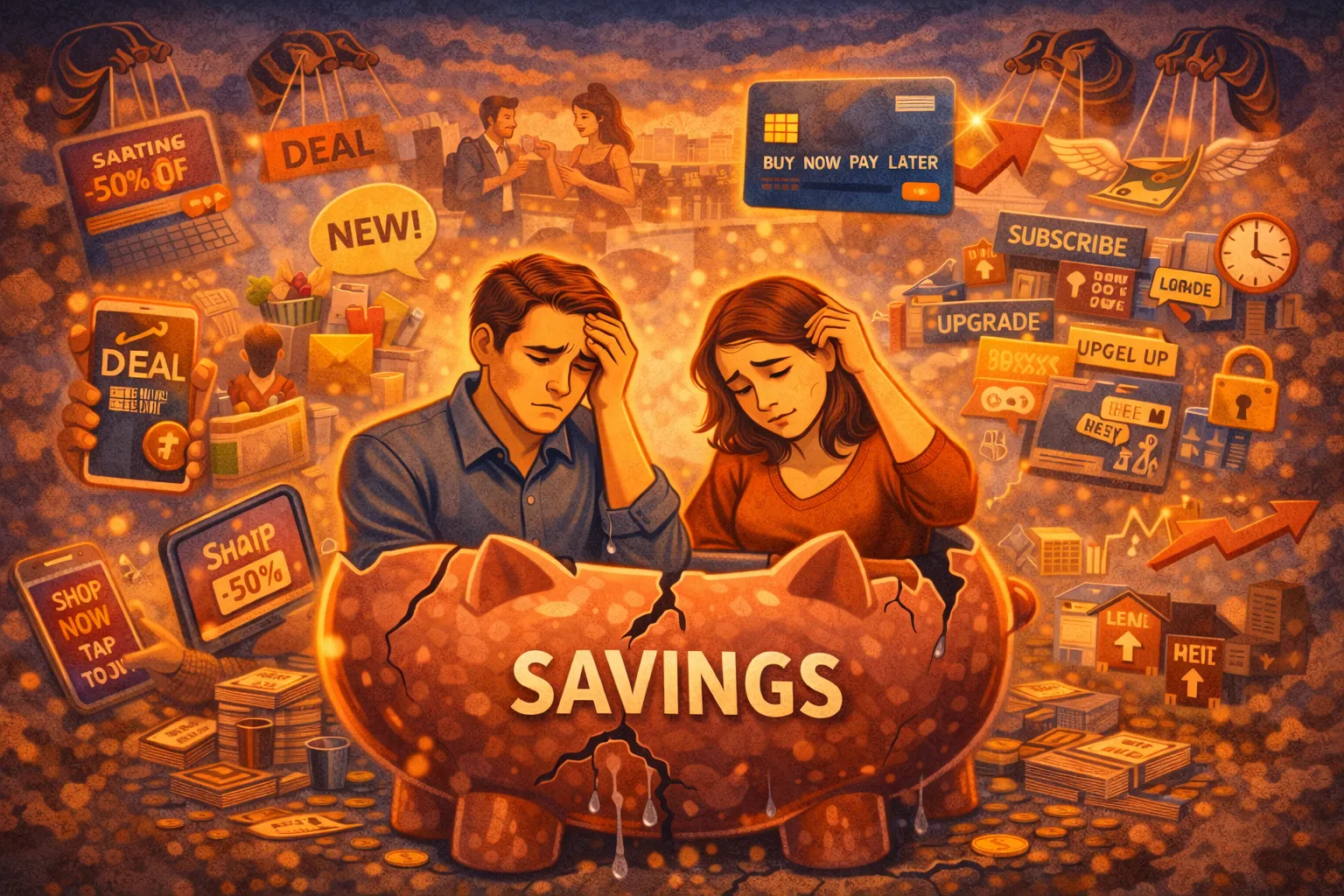
Why we spend the way we do and how modern life exploits our psychological relationship with money. Understanding impulse spending, subscription creep, lifestyle inflation, emotional spending, and buy-now-pay-later traps.

One-click purchasing, algorithmic product recommendations, and buy-now-pay-later options have removed nearly every friction point between desire and transaction.

Why Modern Spending Is Engineered, Not Chosen

The conventional story about spending is simple: people buy things they don't need because they lack discipline. If they just made better choices — fewer lattes, fewer impulse buys, fewer subscriptions — their financial problems would shrink. It's a comforting narrative because it implies a straightforward solution. It's also largely wrong. Modern spending behavior is shaped far more by the environment people operate within than by individual willpower, and that environment has been systematically redesigned over the past two decades to make spending easier, faster, and less psychologically visible than at any point in human history.

The Removal of Friction

Every barrier between wanting something and owning it has been methodically reduced. One-click purchasing eliminates the checkout process. Saved payment credentials remove the step of entering a card number. Biometric authentication replaces even the momentary pause of typing a password. Buy-now-pay-later splits the price into installments that minimize the perceived cost. Same-day and next-day delivery collapse the waiting period that once provided time for reconsideration.

These aren't accidental conveniences. They're the product of extensive research into conversion optimization — the science of turning browsing into buying. According to the Baymard Institute, the average online shopping cart abandonment rate is approximately 70%. Every percentage point of reduction in that abandonment rate represents billions in additional revenue across the e-commerce industry. The entire architecture of modern retail is oriented toward eliminating the moments where a person might pause, reconsider, and decide not to buy. The friction that once served as a natural spending brake has been engineered out of the system.

The Dopamine Economy

Spending triggers a neurological reward response. Research in consumer neuroscience has shown that the anticipation of a purchase activates the nucleus accumbens — the same brain region involved in other reward-driven behaviors. The dopamine release occurs not at the moment of receiving the item, but at the moment of deciding to buy it. This is why the satisfaction of a purchase often fades quickly after the item arrives: the neurological reward was front-loaded into the transaction itself.

Modern retail environments exploit this cycle at scale. Push notifications about flash sales create urgency. Limited-time offers trigger loss aversion — the fear of missing out on a deal produces a stronger impulse than the desire for the product itself. Personalized recommendations, powered by algorithms that analyze browsing history, purchase patterns, and demographic data, present products calibrated to each individual's specific reward triggers. The result is a spending environment that functions less like a marketplace and more like a slot machine — variable rewards, delivered unpredictably, optimized for engagement. The psychological toll of resisting this system every day, across dozens of platforms and touchpoints, is substantial.

Social Spending and the Visibility Gap

Humans have always compared themselves to others. What's changed is the scale, speed, and distortion of the comparison set. Before social media, financial comparison happened within a relatively small circle — neighbors, coworkers, extended family. The reference group was local and roughly similar in economic circumstances. Social media obliterated those boundaries. A person earning $55,000 in Ohio now scrolls past the curated consumption of influencers, celebrities, and peers who present lifestyles that cost multiples of what most people earn.

The visibility gap is critical: spending is visible; financial stress is not. Instagram shows the vacation, not the credit card balance. TikTok shows the haul, not the overdraft. The algorithm amplifies aspirational content because it generates engagement, creating a systematically distorted picture of how people actually live. Research published in the Journal of Consumer Research found that increased social media usage is associated with higher levels of materialistic values and greater financial dissatisfaction, even after controlling for income. People aren't spending more because they want more — they're spending more because their perception of "normal" has been inflated by a media environment that showcases consumption while hiding its consequences.

Subscription Architecture and Recurring Revenue

The subscription model has fundamentally changed the structure of household spending. According to a West Monroe survey, the average American household spends over $200 per month on subscriptions — and most underestimate their total by nearly half when asked. Streaming services, cloud storage, software tools, fitness apps, meal kits, news sites, delivery memberships, and dozens of smaller recurring charges create a fixed-cost floor that rises silently over time.

The genius of the subscription model, from the provider's perspective, is that it converts active spending decisions into passive ones. A one-time purchase requires a decision each time. A subscription requires a decision only to cancel — and cancellation is often deliberately complicated. The default state is continued payment. This inversion of the decision architecture — from opting in to opting out — is one of the most effective behavioral design patterns in modern commerce. It's why companies that switch to subscription models reliably see higher lifetime customer revenue, and why consumers reliably spend more on subscriptions than they intend to.

Emotional Spending as Self-Regulation

Retail therapy isn't a joke — it's a documented psychological phenomenon. Research in the Journal of Consumer Psychology has found that purchasing decisions made during negative emotional states provide a genuine, if temporary, sense of control and mood improvement. When other areas of life feel unmanageable — stagnant wages, relationship stress, health anxiety — spending offers an immediate sense of agency. You can't control your rent increase, but you can choose to buy something that makes you feel better right now.

The problem is that emotional spending creates a cycle. The purchase provides short-term relief. The relief fades. The financial cost of the purchase creates additional stress. The additional stress triggers the desire for another purchase. This cycle is amplified by the same frictionless environment that makes all spending easier: when emotional spending requires nothing more than a tap on a screen, the gap between feeling bad and buying something shrinks to seconds. The emotional regulation function of spending becomes habitual rather than deliberate, and the cumulative financial cost grows without the spender fully recognizing the pattern.

The Asymmetry of Information and Intent

Perhaps the most fundamental problem with the "just spend less" narrative is the asymmetry between individual consumers and the systems working to influence their behavior. A single person managing their spending relies on willpower, self-awareness, and limited information. The companies competing for their money deploy teams of behavioral psychologists, data scientists, UX designers, and machine learning engineers — backed by billions of dollars in research — to optimize every element of the purchasing experience for conversion.

This isn't a fair contest, and framing overspending as a personal discipline problem ignores the industrial-scale effort being deployed on the other side. According to eMarketer, U.S. digital advertising spending exceeded $300 billion in 2024 — roughly $900 per person per year spent specifically on persuading Americans to buy things. Every social media feed, search result, email inbox, and streaming platform carries advertising optimized by algorithms that know more about individual spending vulnerabilities than the individuals themselves do.

Understanding this asymmetry doesn't eliminate the responsibility to manage spending wisely. But it does reframe the challenge. Overspending in the modern environment isn't primarily a failure of character. It's the predictable outcome of operating within a system that has invested enormous resources into producing exactly that result. The path to better spending decisions starts not with guilt, but with recognizing the environment for what it is — and building deliberate structures to protect savings and avoid debt traps in a landscape specifically designed to prevent both.

All Spending Articles