The Psychology of Impulse Buying
You didn't plan to buy it. You didn't need it. But now you own it. Understanding why impulse purchases feel irresistible.
Read article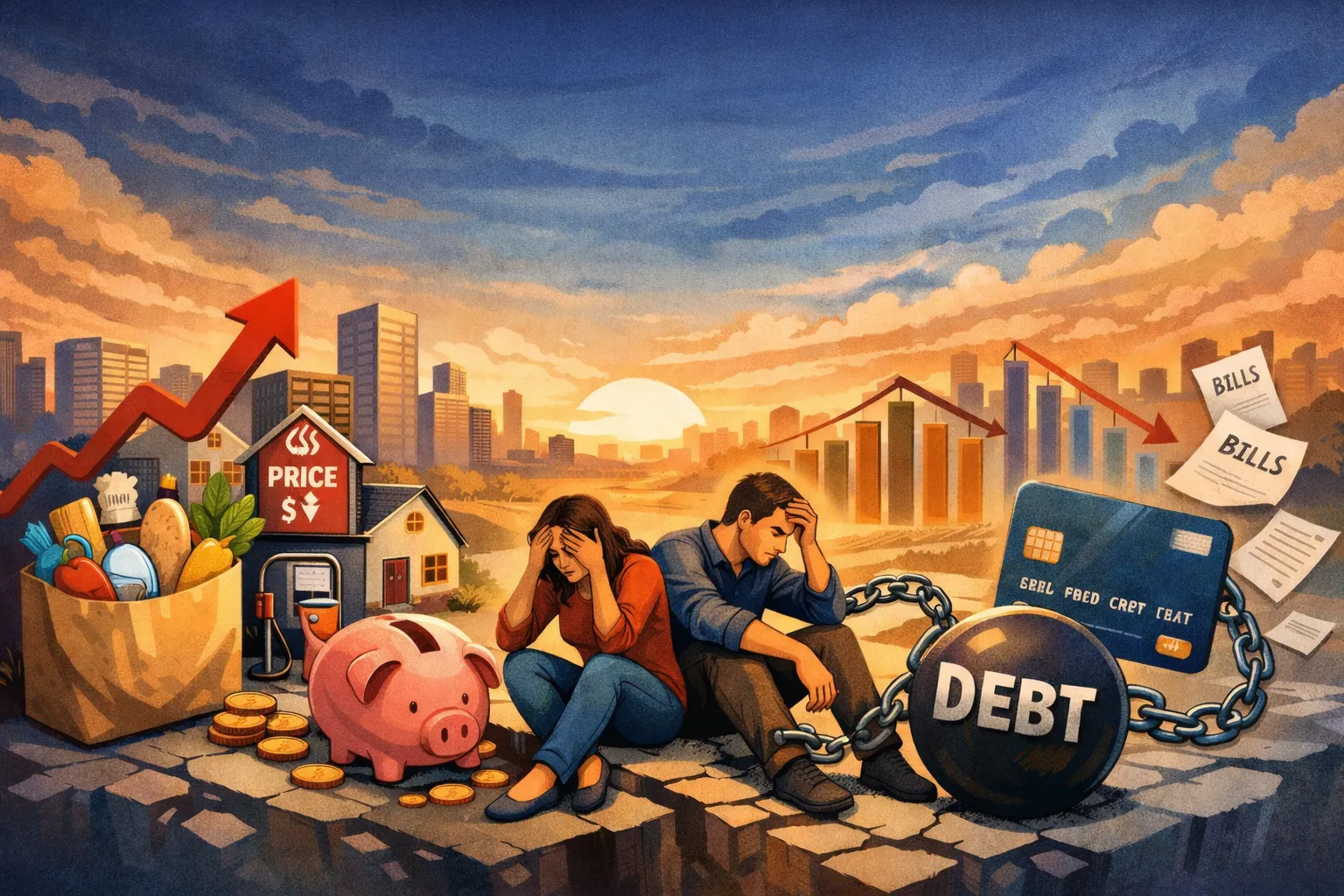
Understanding why money feels harder than it should
Money in modern life isn't what it used to be. Costs rise faster than incomes. Savings feel impossible. Debt becomes a companion rather than a tool. This isn't because you're doing something wrong. It's because the financial landscape has fundamentally changed while the advice hasn't caught up.
If you feel like money doesn't stretch the way it used to, you're not imagining things. The financial landscape has shifted in structural ways over the past several decades, and those shifts explain why so many people — across income levels — feel like they're falling behind even when they're doing everything they were told to do.
The most visible change is the gap between what things cost and what people earn. Between 2000 and 2024, median household income rose roughly 20% after adjusting for inflation. Over the same period, housing costs increased about 55%, healthcare premiums roughly doubled, and public university tuition rose over 100%, according to Bureau of Labor Statistics and Federal Reserve data. The math is straightforward: when the cost of essentials grows two to five times faster than income, the lived experience of money gets harder regardless of how carefully you budget.
This isn't a new trend — it's an accelerating one. For most of the post-war period, productivity gains translated into wage gains. Workers produced more and earned more. That relationship began to disconnect in the late 1970s. Since then, productivity has continued to climb while median wages have largely flattened in real terms. The economic gains have increasingly flowed to corporate profits and top earners rather than to the broad workforce. The result is a growing mismatch between how much value people create at work and how much financial security that work provides.
Debt has filled the gap. Total U.S. household debt now exceeds $17.7 trillion, according to the Federal Reserve Bank of New York. Student loan debt alone surpasses $1.6 trillion. Credit card balances have passed $1.1 trillion, with average interest rates above 22%. A generation ago, debt was something you took on for a house or a car. Today it finances groceries, medical bills, and basic participation in middle-class life. The normalization of debt has reshaped what it means to be financially "normal" — carrying five or six figures of debt is now a common experience, not an exceptional one.
Meanwhile, the structures that once provided financial stability have eroded. Employer-sponsored pensions, which guaranteed retirement income, have been largely replaced by 401(k) plans that shift investment risk entirely to workers. According to Vanguard's How America Saves report, the median 401(k) balance for workers aged 55-64 is approximately $71,000 — a fraction of what most retirement calculators suggest is needed. The social contract between employers and employees has narrowed: shorter job tenures, weaker benefits, and the growth of gig and contract work mean that financial stability depends more on individual navigation than institutional support.
Saving has become structurally harder as a result. According to a Bankrate survey, roughly 57% of Americans cannot cover a $1,000 unexpected expense from savings alone. The standard advice to save three to six months of expenses assumes a surplus that many households simply don't have after covering housing, healthcare, transportation, and childcare. When fixed costs consume 75% or more of household income, the advice to "spend less" stops being useful and starts being insulting.
The psychological toll of these changes is significant. An American Psychological Association survey found that 72% of Americans report feeling stressed about money at least some of the time, making finances the leading source of stress — ahead of work, health, and relationships. Financial shame compounds the problem: because money struggles are still treated as personal failures rather than structural outcomes, people suffer in isolation rather than recognizing a shared experience.
None of this means that individual choices don't matter. They do. But those choices happen within a system that has become significantly harder to navigate than the one previous generations faced. Understanding the system — why costs rise faster than wages, why debt accumulates so easily, why saving feels impossible, why spending pressure is constant — is the first step toward making better decisions within it. That's what this site is for.
Our most comprehensive analysis.
From housing to healthcare, prices have outpaced wage growth for decades. This article examines the structural forces behind rising costs — industry consolidation, supply chain shifts, regulatory dynamics, and the growing gap between productivity and pay — and explains why the same lifestyle that was achievable on a middle-class income a generation ago now requires significantly more.
Covers inflation mechanics, the role of market concentration in pricing, why prices that rise during crises rarely return to previous levels, and what individuals can realistically do to navigate an economy where costs keep climbing.
Read the full analysisA small selection of our most recent pieces.
You didn't plan to buy it. You didn't need it. But now you own it. Understanding why impulse purchases feel irresistible.
Read articleEveryone says to have three to six months saved. Almost no one does. Understanding why building an emergency fund feels impossible.
Read articleYou know it's not rational. Others have less and manage. Yet the shame around your financial situation persists.
Read articleYou borrowed for your future. Now that future feels mortgaged. Understanding why student debt feels inescapable.
Read articleYou started the side hustle to get ahead. But the extra money disappears just like your regular paycheck.
Read articleThe same MRI can cost $400 at an outpatient clinic or $2,800 at a hospital across the street — and your insurance contract determines which price you'll never see upfront.
Read article