Modern Money Life

Financial Stress

Financial Stress

Why money anxiety has become a constant companion for so many people. Understanding the emotional weight of money and why financial peace of mind feels out of reach.

Surveys consistently show that finances are the number one source of stress for American adults, ahead of work, health, and relationships.

Why Financial Stress Became a Baseline State

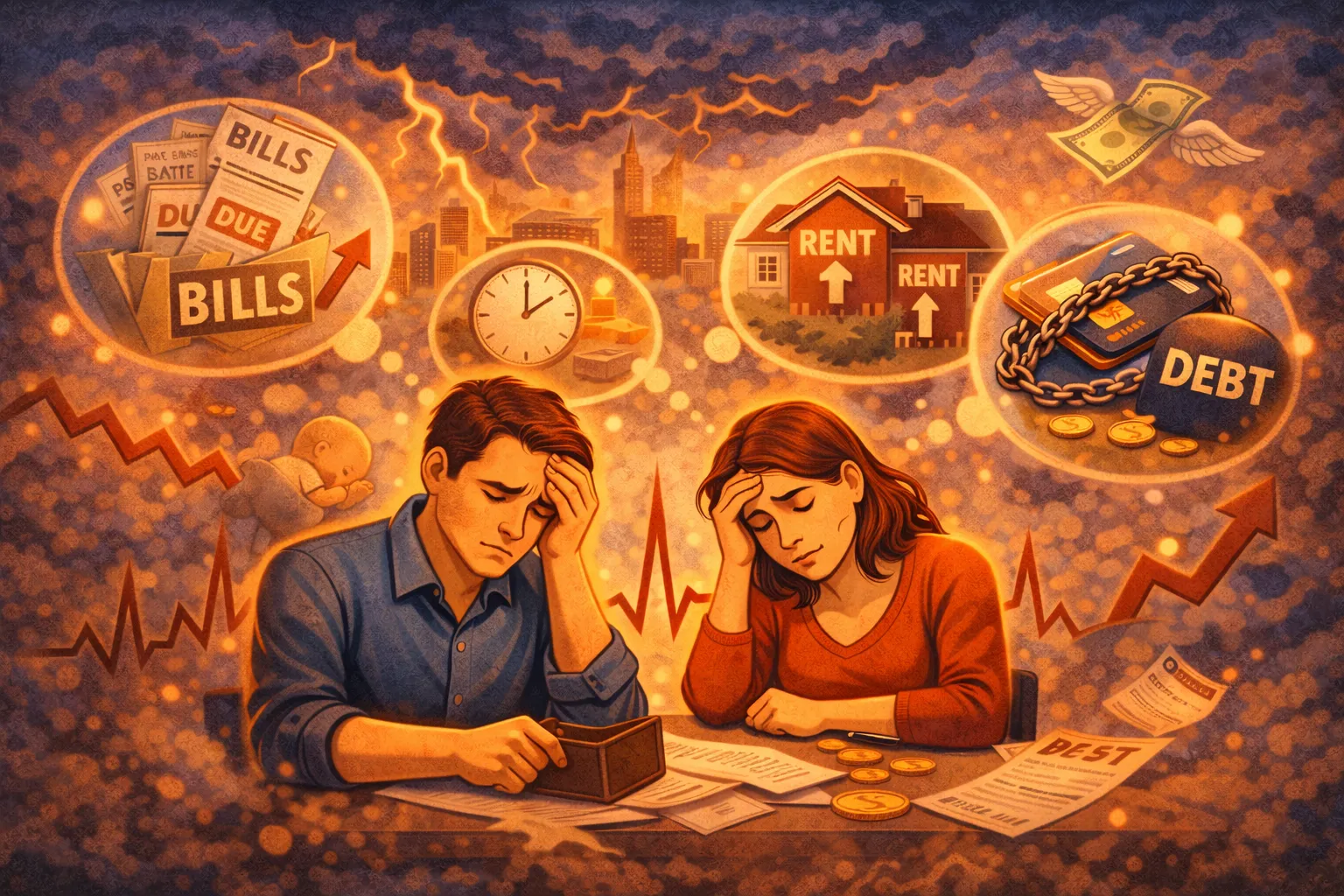
Financial stress isn't an event. For most Americans, it's a condition — a persistent background hum that doesn't resolve when the paycheck clears or the bill gets paid. The American Psychological Association's Stress in America survey has identified money as the leading source of stress for American adults every year since the survey began in 2007. In the most recent data, 72% of adults reported feeling stressed about money at least some of the time, and 22% described their financial stress as extreme. These numbers hold across income levels: households earning over $100,000 report significant financial stress at rates that would surprise anyone who assumes the problem is simply not having enough.

What makes financial stress different from other stressors is that it never fully turns off. A work deadline passes. An illness resolves. A conflict gets settled. But the financial environment — rising costs, outstanding debt, uncertain income — persists continuously. There is no weekend from money. There is no vacation from the awareness that obligations exist, that the margin for error is thin, and that the next unexpected expense could destabilize everything.

Financial Insecurity and the Nervous System

The human stress response evolved to handle acute, short-term threats — a predator, a conflict, a sudden danger. The sympathetic nervous system activates, flooding the body with cortisol and adrenaline, sharpening focus, and preparing for action. When the threat passes, the parasympathetic system restores the body to baseline. This cycle works well for immediate physical dangers. It works poorly for financial insecurity, which is chronic, abstract, and never fully resolved.

Research in psychoneuroendocrinology — the study of how psychological states affect hormonal and nervous system function — has shown that chronic financial stress produces sustained elevation of cortisol, the primary stress hormone. A study published in Social Science & Medicine found that individuals with high debt-to-income ratios showed significantly elevated cortisol levels and higher rates of physical health complaints, independent of income level. The body treats financial insecurity as an ongoing threat, maintaining a low-grade stress response that affects sleep, immune function, cardiovascular health, and cognitive performance. You can know intellectually that an unpaid bill won't physically harm you. Your nervous system doesn't make that distinction.

The Psychology of Chronic Uncertainty

Humans handle known threats better than uncertain ones. Research on uncertainty and anxiety has consistently shown that not knowing is often more stressful than knowing something bad. Financial life in the modern economy is saturated with uncertainty: Will the rent increase? Will insurance premiums go up? Will the car need a repair? Will there be layoffs? Will the side income hold? Each question is individually manageable, but the cumulative weight of dozens of unresolved financial uncertainties creates a state of chronic vigilance that is psychologically exhausting.

This uncertainty is compounded by the complexity of the financial landscape itself. Tax rules change. Insurance networks shift. Investment options multiply. Retirement planning requires projecting decades into a future that is inherently unknowable. The cognitive demand of tracking, managing, and planning across dozens of financial variables exceeds what most people can sustain alongside the other demands of work and daily life. The result is avoidance — people stop opening bills, stop checking balances, stop planning — which temporarily reduces anxiety but ultimately makes the financial situation worse, creating a feedback loop between stress and financial outcomes.

Social Comparison and Financial Shame

Money is the last taboo in American social life. People will discuss their health diagnoses, relationship problems, and political views before they'll share their salary or debt balance. This silence creates a distorted information environment where the primary signals about other people's financial lives come from their visible consumption — homes, cars, vacations, clothes — rather than their actual financial position. The result is a systematic overestimate of how well others are doing and a corresponding underestimate of how common financial struggle actually is.

Social media has amplified this dynamic exponentially. Platforms surface curated images of financial success — new homes, travel, luxury purchases — while financial stress remains invisible. The algorithmic structure of social feeds means that aspirational content generates more engagement, which generates more visibility, which creates an increasingly distorted picture of normal financial life. A person struggling to make rent scrolls past images of peers (or strangers) living apparently effortless financial lives. The comparison triggers shame, which triggers isolation, which prevents the conversations that might reveal how widely shared the struggle actually is.

The shame component is particularly destructive because it reframes a structural problem as a personal failure. When someone believes their financial stress is the result of their own inadequacy — rather than the predictable outcome of an economy where costs outpace wages — they're less likely to seek help, less likely to discuss their situation, and more likely to make anxiety-driven financial decisions that compound the problem.

Financial Conflict and Relationship Strain

Money is consistently among the top sources of conflict in romantic relationships and one of the strongest predictors of divorce. Research by Sonya Britt-Lutter at Kansas State University found that arguments about money are the single strongest predictor of divorce — more predictive than disagreements about children, sex, or household responsibilities. The frequency and intensity of financial arguments predicted divorce regardless of income, debt level, or net worth.

Financial conflict in relationships often isn't really about money. It's about the values, fears, and security needs that money represents. One partner's anxiety about spending reflects a fear of instability. The other's resistance to budgeting reflects a need for autonomy. These are deeply personal psychological patterns, and money becomes the arena where they collide. The structural reality of financial pressure — tight margins, rising costs, insufficient savings — raises the stakes of every financial decision, turning minor disagreements into high-consequence conflicts.

Media Amplification and Economic Doom Scrolling

Financial news has become a 24-hour cycle of crisis narratives. Inflation headlines, recession predictions, market volatility, housing bubble warnings, layoff announcements — the media environment around money is relentlessly negative because negative financial content drives engagement. A headline about stable prices generates no clicks. A headline about impending financial catastrophe generates millions.

The effect on individual stress levels is measurable. Constant exposure to economic threat narratives activates the same stress responses as direct personal financial problems. Someone whose finances are objectively stable can still experience chronic financial anxiety if their media environment is saturated with messages about economic collapse. The perception of financial danger becomes decoupled from the reality of one's own financial position, creating stress that no amount of budgeting or saving can address because it's driven by information consumption, not actual circumstances.

The Normalization of Economic Precarity

Perhaps the most significant shift is that financial insecurity has become so widespread that it's been normalized. Living paycheck to paycheck, carrying five or six figures of debt, having minimal retirement savings, being one emergency away from crisis — these conditions describe the majority of American households. When a condition affects most people, it stops being treated as a problem to solve and starts being accepted as the way things are.

This normalization is psychologically dangerous because it removes the expectation that things should be different. If financial stress is just how life works, there's no reason to examine the structural forces that create it — the wage stagnation, the cost inflation, the benefit erosion, the credit expansion that have reshaped the economic landscape over four decades. The stress becomes personal rather than systemic, individual rather than collective. And personal problems feel solvable only through personal effort, which is precisely the framing that keeps people blaming themselves for outcomes that are largely beyond individual control. Understanding that financial stress is a rational response to an irrational system doesn't eliminate the stress — but it does redirect the energy from self-blame toward clearer thinking about what can actually be changed.

All Stress Articles